1. Introduction: What is Heart Health?
1.1 Defining Heart Health
Heart health is the state in which the heart and blood vessels function optimally to support health and wellbeing, and the prevention, detection and management of cardiovascular disease throughout life. Cardiovascular disease (CVD) is an umbrella term for a range of conditions, some of which are inherited or occur from birth, while others develop over years and decades [1]. Many cardiovascular conditions are linked to the build up of fatty deposits in the arteries, which increases the risk of blood clots that can damage blood vessels supplying the heart, brain, kidneys, eyes, and other organs [1].
1.2 Types of Heart Disease
The cardiovascular conditions of greatest public health significance (either because they are preventable or lead to a high burden of disease) include coronary heart disease, stroke, atrial fibrillation, heart failure, peripheral arterial disease, and aortic disease. These are described in more detail below and are the focus of this report. Other cardiovascular diseases include heart valve conditions, other heart rhythm disturbances, diseases of the heart muscle (cardiomyopathies) and congenital heart disease. The most commonly diagnosed cardiovascular diseases are coronary heart disease and stroke [2].
Coronary Heart Disease
Coronary heart disease (CHD), is the leading cause of heart attacks and the greatest cause of premature death under 75 years in the UK [1]. CHD happens when the supply of blood to the heart is reduced or blocked by a build-up of fatty deposits called plaque in the coronary arteries (blood vessels that supply oxygen-rich blood to the heart), which puts strain on the heart. The most common symptom of CHD is angina, chest pain or tightness similar to the feeling of indigestion. Over time, if left undiagnosed or untreated, CHD can cause the supply of blood to the heart to suddenly get blocked [3]. This can lead to a heart attack or heart failure, which can cause permanent damage to the heart and be life-threatening if not treated immediately [1].
Stroke
Strokes are one of the largest causes of death in England and the leading cause of severe disability in the UK, with two thirds of stroke survivors experiencing some level of disability [2,2]. A stroke is where blood supply to part of the brain is cut off, which can affect speech and movement of the face and arms. The key symptoms of a stroke can be remembered using the word FAST – Face, Arms, Speech, and Time. Recovery from a stroke can take a long time and, in some cases, it can lead to brain damage and death. A transient ischaemic attack (TIA) is a ‘mini-stroke’, where blood flow to the brain is cut off temporarily. A TIA can cause sudden onset of symptoms similar to a stroke, however, the effects do not last as long as a stroke and fully resolve within 24 hours.
Atrial Fibrillation
Atrial fibrillation is where the heart beats in an irregular or random rhythm, which results in the heart not pumping blood effectively. It is estimated that around 1.4 million people have atrial fibrillation in England. It is one of the leading causes of stroke, and people with atrial fibrillation have five times the risk of developing a stroke. However the condition is often symptomless and is commonly undetected and undiagnosed [2,4]. Early detection and management of atrial fibrillation is important for reducing stroke risk.
Heart Failure
Heart failure is where the heart is no longer strong enough to pump blood around the body effectively, causing a build-up of fluid in the lungs and other parts of the body. Heart failure can happen suddenly or gradually over weeks or months. It is most common in older adults and usually gets worse over time. The key symptoms of heart failure include feeling breathless, tired, or faint, finding exercise especially tiring, and swollen legs and ankles [5]. The majority of heart failure diagnoses in England are made in hospital (around 80%), but almost half of the patients diagnosed had symptoms that could have been detected earlier in community settings like GP practices or pharmacies [2].
Peripheral Arterial Disease
Peripheral arterial disease (PAD) happens when there is a build-up of fatty deposits in the arteries, which can lead to a blockage and reduced blood flow to the legs. Although lots of people with PAD do not experience any symptoms, due to slow progression of the disease, it can cause pain, numbness, and weakness in the legs, as well as hair loss and ulcers on the legs and feet. PAD is associated with other types of CVD, including coronary heart disease, stroke, heart attack, and angina [1].
Aortic Disease
Aortic disease is a group of conditions that affect the aorta, the body’s largest blood vessel, which transports blood from the heart to the rest of the body. The most common aortic disease is an aortic aneurysm, where the aorta weakens and swells. An aortic aneurysm is often symptomless, but if it gets bigger, it can cause bulging, pulsing, and pain in the stomach and could eventually burst, which is life-threatening and requires emergency surgery [1].
1.3 Risk Factors for Heart Disease
While some risk factors, such as age, sex and genetic predisposition, cannot be modified, many others are shaped by the environments in which people are born, grow, live, work and age. Understanding cardiovascular risk therefore requires a broad, population-level perspective that extends beyond individual behaviours to encompass the environmental conditions, social determinants of health, and the wider economic and policy contexts that influence health and wellbeing. A life course approach recognises that exposures and experiences across life stages (from before birth through to old age) can accumulate to affect cardiovascular health, contribute to inequalities, and influence the risk of illness and early death from CVD [7]. This highlights the need for action at multiple levels, from supporting healthy behaviours and clinical risk management, to addressing the broader social and structural factors that shape opportunities for good cardiovascular health [8].
It is also noteworthy that CVD and related conditions, including type 2 diabetes and high blood pressure, are increasingly being diagnosed at younger ages [2]. Many cases of CVD, diabetes, and high blood pressure remain undetected and undiagnosed in England, leading to worse health outcomes. High blood pressure in early adulthood is linked to the development of stroke and coronary heart disease and long-term poor health in older adulthood. Coronary heart disease and stroke are significant contributors to disability, reducing the ability of individuals in their later years to lead an active, healthy, and independent life [9].
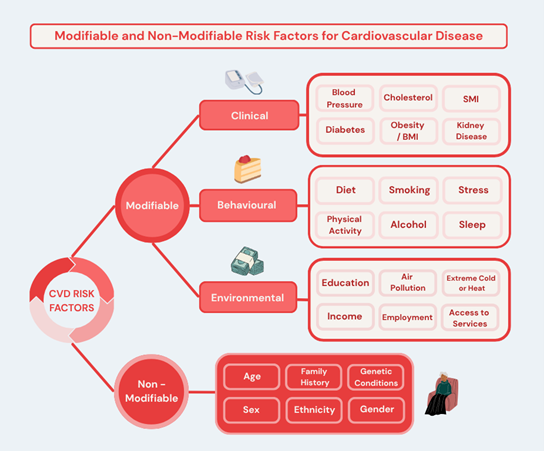
CVD results from a complex interplay of risk factors that influence an individual’s likelihood of developing heart and circulatory conditions over time. Risk factors are characteristics, exposures or conditions associated with an increased risk of adverse health outcomes, and their effects are often cumulative and interconnected. These factors can be broadly classified as either modifiable or non-modifiable.
Non-modifiable Risk Factors
Non-modifiable risk factors are factors that cannot be changed, which increase an individual’s risk of a particular disease or illness. For heart disease, this includes age, sex, gender, ethnicity, family history of CVD, and genetics. CVD risk increases with age and is most common in people aged over 50 years, men, and people from South Asian, Black African, and Black Caribbean ethnic communities [10–14]. People who have close family members related by blood with a history of CVD or specific inherited genetic conditions such as cardiomyopathy (disease of the heart muscle) or familial hypercholesterolemia (high cholesterol levels), are also more likely to develop CVD through shared genes and environments [1]. Research also suggests that transgender people have a higher risk of CVD compared with cisgender people with the same sex at birth [15]. However, CVD is not inevitable and individuals with non-modifiable risk factors can decrease their risk of heart disease by adopting behaviours early on in life that promote good physical and mental health [16].
Modifiable Risk Factors
Modifiable risk factors are factors that can be prevented or managed by an individual making changes to their behaviour or environment, or through medical treatment. In England, modifiable risk factors are responsible for around 90% of coronary heart disease cases [2]. The key modifiable risk factors for CVD can be broken down into clinical, behavioural, and environmental factors [17].
Clinical risk factors include high blood pressure (also known as hypertension), diabetes (pre-diabetes, type 2 diabetes and gestational diabetes), high cholesterol, having a high body mass index (BMI), and serious mental illness [16]. In England, high blood pressure is the greatest modifiable risk factor for CVD, contributing to around 50% of heart attacks and strokes. High blood pressure is the second largest risk factor for all premature death and disability, affecting more than a quarter of all adults in England [1,18]. Type 2 diabetes is another leading risk factor for CVD and is linked to 1 in 10 cardiovascular deaths across England. People living with type 2 diabetes are 3 to 5 times more likely to be admitted to hospital for CVD and 2 to 3 times more likely to develop vascular dementia [2]. The risk of developing high blood pressure and type 2 diabetes is greater in people from South Asian, Black African, and Black Caribbean ethnic communities and living in areas of high deprivation [16,19]. High cholesterol, obesity, and kidney disease are also important risk factors for CVD [11]. People with serious mental illness (SMI), which includes conditions such as psychosis, schizophrenia and bipolar disorder, are 1.5 to 2.5 times more likely to develop CVD and have a greater risk of death from CVD compared to the general population [12,20].
Behavioural risk factors are specific patterns of behaviour or actions adopted by individuals that increase their risk of poor health outcomes. For CVD, these include smoking, physical inactivity, excess alcohol consumption, an unhealthy and unbalanced diet, stress, and poor sleep [16,21]. Smoking is one of the largest preventable causes of CVD and contributes to 14,000 deaths from CVD in England each year [2]. Physical inactivity is linked to a greater risk of both CHD and stroke, contributing to nearly one in ten premature deaths from CHD [22]. Drinking alcohol over a long period of time and in large quantities can increase blood pressure and cholesterol levels, which are leading risk factors for heart attacks and stroke [23]. The prevalence of CVD is also higher in people who have multiple behavioural risk factors [24]. Together, these modifiable behavioural factors account for a large proportion of preventable CVD and are a key intervention opportunity for individuals to reduce their CVD risk through behaviour change.
The wider socioeconomic and physical environments in which we are born, grow, live, work, and age have a considerable impact on our health and wellbeing, including our risk of developing heart disease [25]. Important socioeconomic risk factors for CVD include income and food poverty, insecure employment, manual or shift work, low educational outcomes, and insufficient social connection or support. Significant environmental risk factors for CVD include air pollution, exposure to excess cold and heat from extreme weather events or poor-quality housing, neighbourhood deprivation, and limited access to green spaces and healthcare and community services [2,25,26].
Risk factors are often interconnected and cluster together, which can increase a person’s likelihood of developing CVD across their lifetime. For example, income, food and social insecurity can cause long-term anxiety, stress, and poor sleep. People living in areas of high deprivation are often exposed to more air pollution and fast-food outlets, have reduced access to physical activity, health and community services, and live in poorer quality housing than people living in less deprived neighbourhoods [25]. These conditions make it harder for people to maintain healthy behaviours. However, with tailored and asset-based support, individuals can take positive steps to change their behaviours and significantly lower their risk of developing CVD, such as following a more balanced diet, exercising regularly, reducing alcohol intake and stopping smoking.