2. Policy and Strategic Context
2.1 National Context
NHS 10 Year Plan
The national policy landscape places increasing emphasis on the prevention of cardiovascular disease (CVD). The NHS 10 Year Health Plan sets out three major shifts for the NHS to move the health system towards a more long term and sustainable footing: ‘sickness to prevention’, ‘hospital to community’ and ‘analogue to digital’, all of which are relevant to heart health. It recognises that preventable long-term conditions are a major driver of poor health, health inequalities and demand on health services, and calls for earlier intervention, place-based care within neighbourhoods and a stronger focus on population health. For cardiovascular disease, the plan acknowledges that many heart attacks, strokes and related conditions can be prevented through earlier identification and management of risk factors and greater support for healthier lives. Recognising cardiovascular disease as a major contributor to early deaths and health inequalities, the Government has committed to reducing premature deaths from heart disease and stroke by 25% over the next decade, with the roadmap for achieving this outlined in the CVD Modern Services Framework [1].
CVD Modern Services Framework
Building on the ambitions outlined in the NHS 10 Year Health Plan, the Cardiovascular Disease Modern Service Framework, sets out more detailed recommendations and priority actions to accelerate progress in reducing premature deaths from CVD. The framework adopts a holistic cardiovascular-kidney-metabolic (CVKM) approach, recognising that many risk factors and conditions - such as high blood pressure, high cholesterol, high blood sugar, obesity, smoking, chronic kidney disease and atrial fibrillation - often share common causes, cluster within the same individuals, and together drive most heart attacks and strokes. In particular, the framework highlights the need to identify and manage the “missing millions” of people living with undiagnosed or poorly controlled risk factors, and that addressing these risks in a coordinated and holistic way offers the greatest opportunity to improve CVD outcomes [2]. The framework promotes priorities across four main themes, with national standards defined for each alongside equity measures to tackle unwarranted variation:
- Finding the ‘Missing Millions’ of people living with undiagnosed or poorly controlled risk factors
- Driving treatment to target, for blood pressure, cholesterol, diabetes, chronic kidney disease and heart failure
- Ensuring timely, equitable, high quality acute care for strokes and heart attacks
- Living with CVD and expanding access to cardiovascular rehabilitation.
Outside of these core priorities, the framework also outlines wider actions and opportunities for the future as technologies develop, including the potential role of digital and app-based technology, wearables, remote monitoring, point of care testing and self-testing, AI-enhanced risk factor detection, genomics and other innovations in medical technology.
The Core20PLUS5 Framework
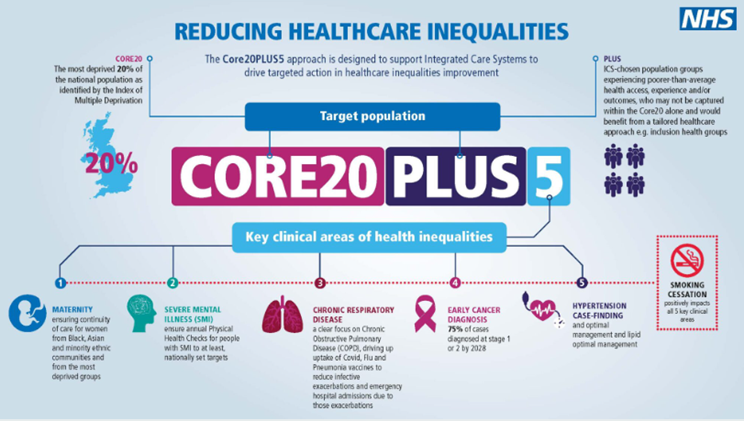
The Core20PLUS5 framework remains the NHS’s principal approach to reducing healthcare inequalities, and can be used to inform targeted approaches to ill health prevention [3]. By targeting the most deprived 20% of the population and other high‑risk groups, the framework helps direct preventive efforts to the communities where they can have the greatest impact. Within its five clinical priorities, the framework highlights hypertension case‑finding and management and optimal lipid management as key levers to address inequities in cardiovascular outcomes. We know that cardiovascular risk factors such as high blood pressure, diabetes, and smoking remain disproportionately concentrated in deprived areas, driving higher rates of hospital admissions and premature mortality.
2.2 Regional Context
London Million Hearts and Minds
The London Million Hearts and Minds (MHM) Programme is a city-wide CVD prevention programme led through a partnership between the NHS, the Mayor of London, London boroughs, voluntary and community organisations, academic institutions and other partners [4].
By 2030, the programme aims to ensure up to 661,000 more people receive the best possible treatment for high blood pressure and high cholesterol, helping to prevent around 3,000 heart attacks and strokes, through a ‘Once for London’ approach. The programme aims to share best practice and use simple London-wide messages, encouraging Londoners to use existing services like NHS Health Checks and pharmacy checks, while expanding blood pressure checks to other settings, communities and workplaces, while supporting data-driven approaches to identifying individuals at risk.
The year 2025/26 was a foundational year for the programme, with activities focusing on raising awareness and building partnerships, campaign planning and development, delivery of London-wide CVD Prevention Summit, and onboarding of 8 MHM Pioneers with a focus on workplace health. Plans for 2026/27 include a regional MHM public awareness campaign with an initial focus on hypertension, development of toolkits and resources for community engagement, and enabling workstreams to support the scaling of innovation and best practice across the system.
2.3 Local Context
Across the five boroughs of North Central London (NCL), cardiovascular disease and its major risk factors, particularly hypertension, have been recognised as significant contributors to premature mortality and health inequalities, and as such, improving heart health has been a key priority within the NCL Population Health and Integrated Care Strategy.
In primary care, the NCL Long Term Conditions Locally Commissioned Service (LTC LCS) has introduced a proactive, personalised model of care that combines systematic case-finding with annual holistic reviews and treatment-to-target approaches for long-term conditions. A major focus has been hypertension, with practices supported through population health management tools, electronic case-finding searches and incentives to improve both its diagnosis and management.
Alongside this, Primary Care Network (PCN) Neighbourhood Hypertension Champions have led local initiatives to increase the detection of undiagnosed hypertension, strengthen links between general practice, pharmacies, community organisations and residents, and support the development of neighbourhood-based approaches to cardiovascular prevention.
From April 2026, NCL Integrated Care Board (ICB) formally merged with North West London (NWL) ICB to create NHS West and North London, serving approximately 4.5 million residents across 13 boroughs. While both systems have shared commitments to prevention, neighbourhood health and reducing inequalities, they have developed different primary care models and programmes for long-term condition management. The merger therefore presents an opportunity to align these approaches, share learning at scale, and develop a more consistent model for case-finding, personalised care and treatment-to-target across the wider system.
System-wide action is being taken on a range of behavioural risk factors for cardiovascular disease including smoking, physical inactivity, unhealthy weight, and harmful alcohol consumption. This includes:
- Ensuring access to effective services, such as Breathe’s specialist stop smoking service, Arsenal in the Community’s Shape Up programme for men, and the general practice-focused Get Active Service, which supports inactive residents with one or more long-term conditions.
- Providing training and support for frontline staff to identify need and make effective referrals, including identification and brief advice training on harmful alcohol use.
- Supporting action in community settings, including workplaces and schools.
- Delivering effective campaigns that engage residents and encourage behaviour change, such as Know What You’re Drinking and Active for Life.
- Working with trusted voluntary and community sector (VCS) organisations to improve reach among groups with greater need, including stop smoking support delivered by organisations such as Queens Crescent Community Association.