Introduction
This needs assessment is intended to improve the understanding and awareness of violence against women and girls (VAWG) in the London borough of Camden, in order to inform strategy development, commissioning plans, and staff practice. The United Nations (UN) defines VAWG as “an act of gender-based violence that results in, or is likely to result in, physical, sexual or psychological harm or suffering to women, including threats of such acts, coercion or arbitrary deprivation of liberty, whether occurring in public or in private life”.[3]
Within We Make Camden[4] – the Council’s shared vision for the borough – there is a commitment to make Camden a fairer and more equal place with safety at home and in the community as one of the challenges the strategy looks to address. Eliminating VAWG is a prioritised work area in the strategy. In addition, improving women’s safety in public spaces and taking effective action to address gender-related crime is a priority within the borough’s Community Safety Partnership Action Plan (2024-2027).[5]
It is a statutory requirement[6] for local authorities to conduct a DVA needs assessment locally, however this requirement is limited to accommodation-based support services. To better align this needs assessment with the corporate strategy, this needs assessment will be broader in scope to provide a holistic understanding of VAWG in the borough, and in turn, a comprehensive strategy and support offer.
This needs assessment will provide contextual information about VAWG including: (i) why it is considered a priority area of work for the Council; (ii) political and legal context locally, nationally, and globally; (iii) the snapshot of local data and the scale of the issue in Camden at the time of the needs assessment; (iv) views and insights from people with lived experience, the community, and stakeholders; (v) the current offer of support and response available in Camden; and (vi) recommendations for next steps.
This needs assessment will use data available within and to the council as well as collected locally, and best practice which is available publicly or shared with the council. While the term VAWG highlights the gendered nature of the issue, this needs assessment will include all children, rather than just girls. This expanded scope recognises that all children in families which experience violence within the home or family are affected, even if girls are typically targeted more often than boys.[7]
The needs assessment has been developed through a collaborative process led by the public health team, and with contributions by members of the corporate strategy, corporate data, children’s & learning, and adults & health teams who focus on DVA, VAWG, supporting families, and/or community engagement.
In compiling this report, we acknowledge the substantial work already undertaken by the local authority and its partners to address VAWG and DVA. The commitment, professionalism, and sustained effort of those working in this field are evident and commendable. The purpose of this report is not to assess past or current work, but to support future progress by highlighting current challenges and areas where further development may be beneficial. The findings should therefore be considered within the context of the strong foundations and positive initiatives already in place.
Background
What is Violence Against Women and Girls?
Violence against women and girls (VAWG) is defined by the United Nations (UN) as “gender-based violence, that is, violence that is directed against a woman because she is a woman or that affects women disproportionately. It includes acts that inflict physical, mental, or sexual harm or suffering, threats of such acts, coercion and other deprivations of liberty.”[8] While it is recognised that men also experience violence and abuse, this definition highlights the disproportionate impact of violence on females. For this reason, VAWG has been identified as a priority area of intervention globally.
Beyond domestic violence and abuse (DVA) and sexual assault, VAWG can also include female genital mutilation, stalking, abuse of other kinds (e.g. financial, psychological, and verbal), coercive control, forced marriage, harassment, trafficking, and honour-based violence. However, most data available and work in this area is related to DVA and sexual assault due to the high incidence of these crimes and the significant impact on victims/survivors.
Why is Violence Against Women and Girls an important issue?
Globally, it is estimated that almost one in three women have experienced physical and/or sexual violence at least once in their lifetime,[9] and the World Health Organisation (WHO) has identified VAWG as a “major public health problem and violation of women’s human rights.”[10]
The impact of violence on the health of women incudes death, physical injuries and symptoms, mental health issues, and increased need for health care due to injuries, ongoing care needs, unintended pregnancies, sexually transmitted infections, abortions, and pre-term or low birth weight babies.[11]
In addition to the impact on the woman themselves, children who grow up in families who experience violence are likely to have behavioural and emotional needs, may also experience or demonstrate violence as they get older, and are more likely to have higher rates of health conditions or early mortality.[12]
In order to address this issue and prevent violence against women, the WHO developed the RESPECT framework[13] for policy makers. They have also summarised the impact of VAWG and opportunities for prevention in an ecological model of VAWG.
The government in England introduced the Domestic Abuse Act[14] and Tackling VAWG strategy[15] in 2021 and are currently undertaking a Public Accounts Committee inquiry to understand how VAWG is being prioritised and prevented by the Government. The Crime Survey for England and Wales from March 2022[16] shows that over one in four women are victims/survivors of sexual assault or attempted assault in their lifetime, and one in 12 are victims/survivors of VAWG each year (although it is noted that this is likely up to 79% higher due to people not reporting incidents).[17]
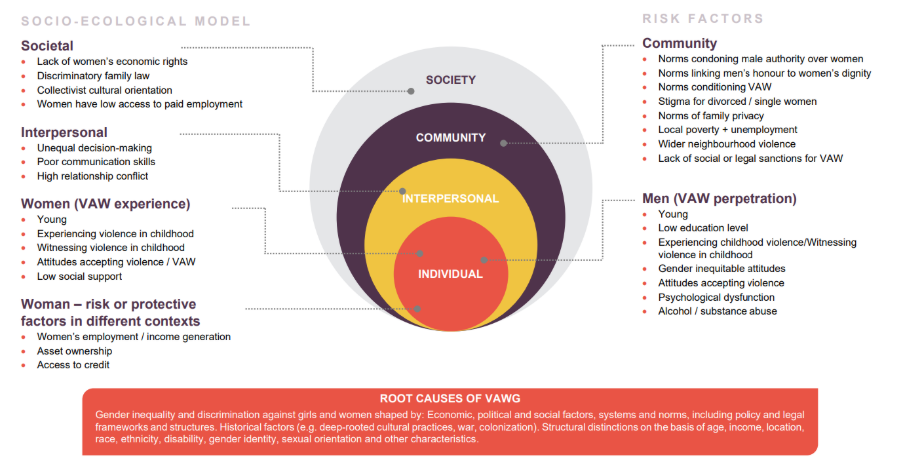
Figure 1: Ecological model of Violence Against Women and Girls, United Nations RESPECT Guide and Workbook (2020)
In addition, the National Police Chief’s Council (NPCC) called for a whole-system approach to addressing VAWG as they found that VAWG-related crimes accounted for 20% of all recorded crimes by the police and had increased by 37% between 2018 and 2023.[18] For the year ending March 2024, the Office of National Statistics (ONS) reported that approximately 7.4% of women experienced DVA in the last 12 months (an increase from 6.5% in the year ending March 2023), and 72.5% of domestic-abuse related crime victims were women.[19]
Estimates using national prevalence statistics suggest that over 14,000 residents of Camden experience DVA each year.[20] Furthermore, the charity Women’s Aid has calculated that the cost of supporting victim/survivors of DVA could be approximately £180,000 to support one person but could be reduced to approximately £20,000 if intervention happens early.[21] Additionally, it can cost victim/survivors up to £50,000 to leave an abusive situation.[22]
Considering the financial challenges many Camden residents face on a day-to-day basis, as well as the additional impact of the cost of living crisis, and the resource pressures public services such as the Council and NHS are facing, reducing VAWG is beneficial for the individuals affected, their families, and the system at large.
Needs assessment process
A needs assessment provides an overview of the needs of a population – usually a specific group (e.g. users of a service, age group) – and is often based on a particular health-related issue. Needs assessments summarise the data and current service provision (as well as any gaps) to produce a set of actionable recommendations based on best practice and evidence, to inform the strategy development and future commissioning intentions.
Conducting a needs assessment will ensure the development of the borough’s VAWG strategy is informed by data and evidence; relevant to the needs of victim/survivors and those impacted by VAWG; targeted as necessary; and effective. The needs assessment provides a holistic view of the need in the borough as well as providing a baseline to evidence the impact of the subsequent strategy.
In order to ensure the recommendations are as informed as possible, the needs assessment will collate quantitative and qualitative data from a range of sources including the Council, local service providers and voluntary sector partners, professionals who work with the population / condition the needs assessment is focused on, and the people who are going to be impacted by the assessment’s recommendations and the subsequent strategy. The needs assessment will also summarise the relevant political and legal context, best practice, and evidence for interventions that are effective. Together, the data and evidence will contribute to the recommendations in the needs assessment, which will, in turn, inform the strategy.
Rationale
While there are multiple VAWG-related services provided by Camden Council and a range of other providers across the borough, the borough has not yet conducted an overarching needs assessment of VAWG.
In Camden, community engagement during the development of the We Make Camden Vision[23] raised the issue of VAWG as an area of concern for residents. Leading to the identification of ensuring that everyone in Camden feels safe at home and in the community as a challenge that the Council is aiming to achieve over the coming years. Therefore, with plans to develop a VAWG strategy in place, it is necessary to undertake a needs assessment to ensure the strategy is developed with as much information and insight as possible.
The needs assessment is being led by Health and Wellbeing and delivered in partnership with colleagues from across the Council who bring expertise in the data and service provision available across the borough.
Scope
It is important to define the scope of a needs assessment to ensure the purpose and intended impact is clear as well as to guide the needs assessment development. As set out above, the scope of a needs assessment can be defined by the population and health-related issue it is focused on – as set out below.
Population of Focus - Women and children impacted by violence, who live in Camden.
Justification - This population is disproportionately affected by violence, and reflects the remit of control which the Council has to make change.
Health-Related Issue of Focus - Understand the needs of people impacted by violence against women and girls (VAWG) using the full UN definition.[24]
Justification - It is important to recognise the breadth of VAWG and its impact in order to develop a strategy which can address both the root causes and the response required which is comprehensive and understands the different types of violence which can affect people.
While the Council recognises that a range of people are affected by a range of health-related issues, and there are multiple complexities and intersectionality to consider, it is important to define a needs assessment in order to contain it and make it practical for those creating, reading, and using it. This needs assessment is framed within existing definitions of VAWG. As such, it primarily addresses the experiences of women and girls. This reflects the way VAWG is currently defined in national and international policy frameworks, as well as limitations in available data. We acknowledge, however, that other genders also experience gender-based violence, however, this is outside the scope of this assessment.
This needs assessment is intended to provide an overview of the impact and consequences of VAWG including the opportunities for prevention and response. As the first needs assessment of its type for Camden, it provides a crucial understanding of the situation overall, acting as the basis for future work and a baseline for evaluating relevant strategies.
Alongside this needs assessment, a deep dive is being undertaken to understand the mental health needs of people who are impacted by DVA. This overarching VAWG needs assessment will act as the foundation and context for the mental health-focused deep dive. Further deep dives will take place on other priority areas, ensuring that our understanding continues to grow and evolve. While this assessment provides a snapshot in time, it is intended to be a living resource that can be added to and refined. This ongoing approach is crucial, as it allows us to build a richer picture of need and respond in a timely and informed way to the changing experiences of those affected.
Aims and objectives
The aims and objectives of this needs assessment are to:
Provide an understanding of VAWG and its political and legal context
Collate and summarise the prevalence and scale of VAWG in Camden
Map the current provision of services to support people involved in and impacted by VAWG
Explore the evidence base of best practice and effective interventions to prevent and respond to VAWG
Evaluate the local response to VAWG
Suggest evidence and data informed recommendations for subsequent strategies, policies, commissioning, and practice
It is expected that the needs assessment will be used to inform a Camden VAWG strategy, and by local partners (e.g. local safeguarding board, police, service providers) to inform programmes of work and support a collaborative, multi-agency approach to preventing and responding to VAWG in Camden.
Limitations
Despite a significant amount of quantitative and qualitative data being collected and assessed for this report, the data available was primarily related to DVA. There is a lack of data for other elements of VAWG across organisations and services, in part due to the way data is collected and potentially due to the sensitive or hidden nature of VAWG (e.g. forced marriage, female genital mutilation, stalking, and online abuse). Therefore, this needs assessment was not able to fully describe or assess the need for all other areas of VAWG.
Whilst a wide range of insight and focus group discussions were conducted for this report - including commissioning external partners to engage with groups who may otherwise choose not to engage directly with the Council - it is recognised that not all perspectives will be captured. The very personal nature of the topic, alongside cultural norms and stigma, means that some experiences are likely to remain unspoken, particularly within group discussion settings. Given the resources available to complete this needs assessment, it was not possible to carry out additional data collection within the timeframe, or to conduct individual interviews which may have elicited additional insights. To address this, existing insights were incorporated where appropriate, and plans for further engagement to build on this evidence base are set out in the needs assessment.
Finally, due to the nature of VAWG and the wide range of roles and responsibilities across the council, as well as the likelihood of contact with those affected, we have tried to reflect the work taking place within the local authority. However, we recognise that we may not have captured all of the valuable contributions being made by everyone.