Developing topic guides
Talk based methods
A well-designed topic guide (sometimes called a discussion guide) is essential for carrying out high-quality interviews and focus groups. A topic guide isn’t just a long list of questions, but instead a structured tool that helps you steer a conversation in a way that is purposeful and responsive to participants.
See Healthwatch’s Qualitative Methodology and Discussion Guide
What is a topic guide?
A topic guide is a flexible framework that outlines the key areas you want to explore during an interview or focus group. It includes a series of questions which help guide the discussion with your participants.
Topic guides usually include:
Core topics aligned to your research aims
Open-ended questions to introduce each topic
Prompts or probes which help to explore issues in more depth
Notes on timing, flow, or sensitivity
Unlike surveys, topic guides are not designed to be followed word-for-word. They are used flexibly, allowing facilitators to respond to what participants say, their language, and experiences.
What does a good topic guide look like?
A good topic guide will be:
Clearly linked to your research aims and objectives
Concise and focused, avoiding unnecessary or ‘filler’ questions
Written in accessible, plain language (language that you would use every day)
Used flexibly, allowing the conversation to flow naturally
In practice, your topic guide might fit on one or two pages and be structured around a small number of core themes rather than a long list of questions.
How many questions should my topic guide have?
The length of your topic guide will depend on your method and design.
A well-designed topic guide uses a small number of thoughtfully written questions, ordered in a logical flow, rather than a long list of questions that are included “just in case.” Aim for as few main questions as possible and use prompts and probes to get depth.
In focus groups, much of the value comes from participants discussing and responding to each other, which takes time. In interviews, you can usually include more questions/topics because pacing is easier to control.
| Number of participants/activity | Maximum number of questions |
|---|---|
| Large focus groups (e.g., 6+ participants) | Up to 6 main questions |
| Smaller focus groups (e.g., 3 to 5 participants) | Up to 8 main questions |
| One-to-one interviews | Up to 10 main questions |
Key question types
Your topic guide will include a few different types of questions. Some of these will be key open-ended questions which form the basis of your interview or focus group, whilst others (e.g., probes, prompts) can encourage participants to open up and provide more detail.
Open-ended questions
Open-ended questions invite participants to describe experiences in their own words and should form the backbone of your topic guide.
Examples:
“Can you tell me about your experience of using this service?”
“Can you tell me a bit about yourself, and your role?”
Probing questions
Probes help you explore issues in more depth without leading participants. You don’t need to prepare probes for every question, but there might be some questions where this will be useful. Examples:
“Can you tell me a bit more about that?”
“In what way did that affect you?”
“Has anyone else had a similar experience?”
Prompts
If you have specific questions that aren’t being discussed naturally or after probing, you can prompt to suggest ideas.
However, do this with caution! Prompts should be reserved for the most important points and used cautiously as you risk leading participants to answer in a specific way. Examples:
“How does that compare to what you expected?”
“Looking back, what would have improved your experience?”
“What do you think services could learn from that experience?”
| Question | Probe | Prompt |
|---|---|---|
| How has taking part in the programme affected you or your family? | Can you tell me a bit more about that impact? | Has it changed how confident you feel, or how you use other services? This could be in a positive or a negative way, or anywhere in between. |
Sequencing questions to build rapport and depth
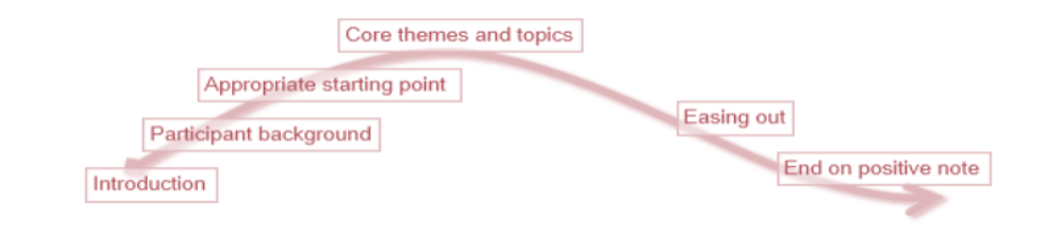
The order of your questions matters, and it is important to organise your questions so that they flow logically. A well-sequenced topic guide helps build trust and encourages openness.
Consider using the funnel or inverted triangle method - begin with general, contextual questions, and move towards more specific or reflective questions once you have built up rapport with your participant(s).
Begin with open, contextual questions (e.g., background or role)
Move into experiential questions about specific interactions or events
Explore interpretation and impact
End with reflective or forward-looking questions (e.g., improvements)
Structuring for sensitivity and challenging topics
When designing topic guides for interviews or focus groups, particular care is needed if the research involves sensitive or potentially distressing topics.
How and when these topics are introduced can really impact participant comfort, trust, and willingness to engage.
Sensitive or challenging topics should be:
Introduced gradually rather than early in the conversation
Clearly signposted (e.g. “I’m going to ask about something a bit more personal now, if that’s okay”)
Framed in a way that gives participants choice and control
Avoidasking directly about distress or harm. Instead, use open, indirect phrasing that allows participants to define what feels relevant to them.
“Were there any parts of that experience that you found particularly challenging?”
“Is there anything about that experience you would rather not talk about today?”
It is important to normalise participants’ right to set boundaries. This can be built into both the topic guide and the way questions are introduced. You can:
Remind participants that they can skip questions or stop at any point, or offering pauses or breaks (e.g., “We can move on, or take a short break, if that would help”)
Pay close attention to non-verbal cues that someone may be uncomfortable(e.g., facial expressions and eye contact, body posture and position, behavioural cues like long pauses)
Using vignettes
Vignettes (short fictional or hypothetical scenarios presented to participants during an interview or focus group) can be a useful technique for opening up discussion on topics that might otherwise be difficult to explore directly.
By inviting participants to respond to a scenario rather than sharing their personal experiences, vignettes make it easier for participants to engage with sensitive or complex issues without feeling judged or defensive.
These can be particularly useful when speaking to professionals as they can surface how practitioners make decisions in practice, rather than how they feel they should respond. For example, asking a school nurse “what would you do in this situation?” can yields richer, more honest insight into real-world decision-making versus than asking directly about their practice.
Vignettes work best when they are realistic and recognisable to participants. They are typically followed by probing questions that draw participants from the scenario towards their own experiences or views.
Dos and don’ts for developing your topic guide
Below are some do’s and don’ts to keep in mind when developing your topic guide.
Do:
Start broad, then refine Begin by brainstorming a longlist of possible questions, then refine them based on what you really need to know.
Link your questions to your aims and objectives Refer back to your project aims, objectives, and protocol to ensure every question serves a clear purpose.
Use open, neutral wording Ask open-ended questions that invite detailed responses and avoid language that implies a “right” answer.
Expect to draft and redraft Topic guides improve through iteration. Build in time to revise your guide based on feedback.
QA and test your guide Ask colleagues to review your topic guide for clarity, accessibility, and alignment with your aims. Formal piloting may not always be feasible, but informal testing with colleagues can help identify unclear wording, poor flow, or assumptions.
Consider cultural appropriateness Reflect on how questions might land with participants from different backgrounds or communities.
Include a final open question Always end with a question that allows participants to raise issues that matter to them or mention anything you didn’t ask about.
Don’t:
Use leading or loaded questions Avoid wording that steers participants toward a particular answer or interpretation (e.g., how has the programme improved your physical activity levels?)
Ask double-barrelled questions This makes it unclear which part the participant is responding to – ask one question at a time (e.g., how satisfied are you with the quality and speed of the service?)
Overload the guide with too many questions A shorter, well-focused guide is usually more effective than an exhaustive one.
Use jargon or technical language where it’s not needed Identify and remove unclear terms when testing your topic guide.
Introduce sensitive topics abruptly Avoid jumping straight into personal or challenging questions without signposting or building rapport.